G14Before you buy line · 7 min read · updated 23 Sep 2026
How to read a cannabis label
The universal symbol, THC per serving and per package, batch and lot numbers, lab certificates, dates and warnings: what California and New York require on every licensed package.
The short answers
- Every licensed package in California and New York carries the state's universal symbol, and OCM says you will see it on all legal adult-use products.
- Edibles list THC in milligrams per serving and per package, capped at 10 mg per serving and 100 mg per package in both states.
- Flower lists THC as a percentage; New York calculates total THC as THC plus (THCA x 0.877).
- New York labels carry a QR code or bar code to the lab's certificate of analysis, and a California shop may sell a product only if its batch number matches that certificate.
- Label figures have a tolerance: plus or minus 10% in California, and 85% to 115% of the labeled amount in New York.
A licensed cannabis label is set by state rule. In California and New York, the package must show the universal symbol, the cannabinoid content, a batch or lot identifier, required warnings and dates, and OCM says the universal symbol appears on all legal adult-use products.
Those numbers are lab measurements, not dosing instructions. The sections below go through each element with the California regulation (Title 4 of the California Code of Regulations) or New York regulation (Title 9 NYCRR) that requires it. For how edibles differ from smoking, read the edibles basics guide.
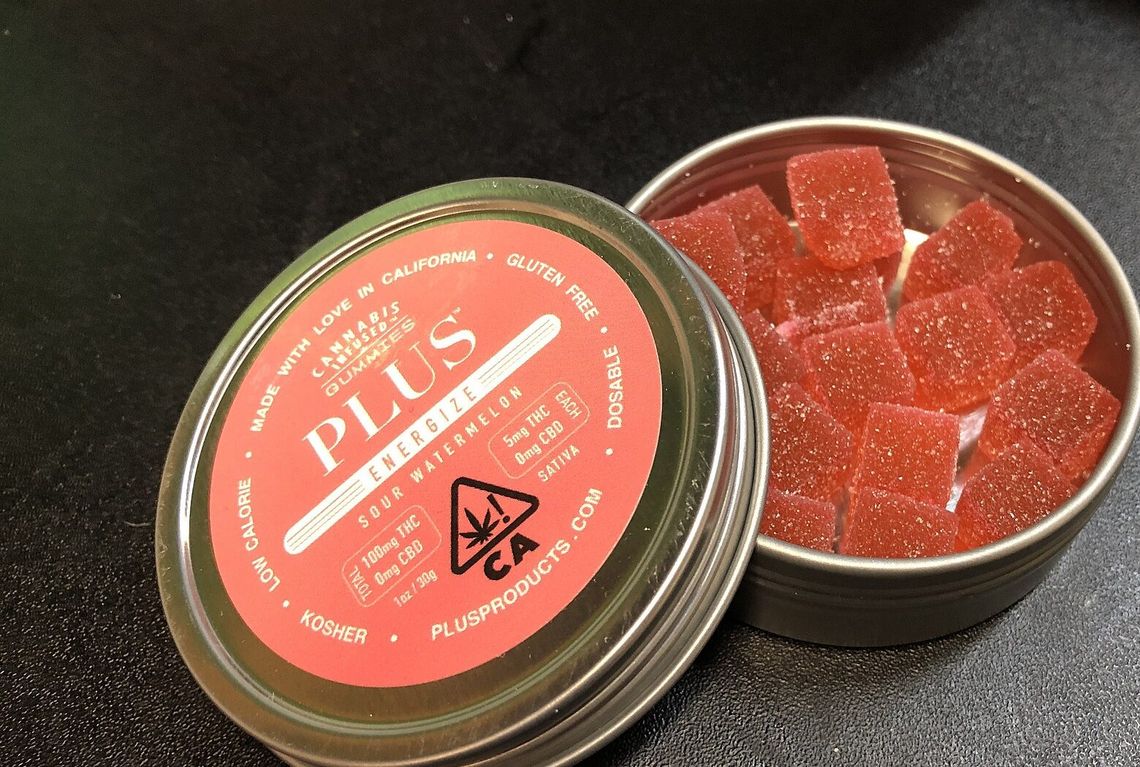

What is the universal symbol and where do I find it?
The universal symbol is the state mark that says a product contains cannabis, and every licensed package must carry it. California puts it on the primary panel of flower and manufactured products (4 CCR 17403(a)(3), 17404(a)(2)), and New York requires one of three state universal symbols on the package (9 NYCRR 128.5(b)(6)).
California's symbol must be black or white on a contrasting color and at least 0.5 inch tall, with a 0.25 inch version allowed on vape cartridges and devices (4 CCR 17410). New York sets minimum sizes too, including 1.25 inch in height for the square version (9 NYCRR 128.5(b)(6)).
OCM says you will see the symbol on all legal adult-use products. California's public-health department suggests teaching children not to eat or drink anything with the symbol on the package.
SourcesCalifornia Department of Cannabis Control: Medicinal and Adult-Use Cannabis Regulations (revised 1 Jul 2026)New York Office of Cannabis Management: Adopted Parts 128 and 129 (9 NYCRR)New York Office of Cannabis Management: How to Read an Adult-Use Cannabis LabelCalifornia Department of Public Health: Cannabis Safety Measures
What does the THC number mean on flower versus edibles?
Flower shows THC as a percentage; edibles show milligrams per serving and per package. California labels flower with Total THC as a percentage and edibles with THC and CBD in milligrams per serving and per package (4 CCR 17407(b)).
New York's front panel shows, for products that are not inhaled, total THC and total CBD in milligrams per serving and per package, the number of servings per package and the recommended serving size. For inhalables it shows total THC as a percentage of weight or volume (9 NYCRR 128.5(a)).
New York defines total THC on the label as THC plus (THCA x 0.877) (9 NYCRR 128.5(a)). California infused pre-rolls list either the cannabinoid content in milligrams or the flower's percentage plus the added cannabinoids in milligrams (4 CCR 17407(b)(4)).
OCM's edibles card says a higher THC percentage does not necessarily mean a better cannabis experience.
SourcesCalifornia Department of Cannabis Control: Medicinal and Adult-Use Cannabis Regulations (revised 1 Jul 2026)New York Office of Cannabis Management: Adopted Parts 128 and 129 (9 NYCRR)New York Office of Cannabis Management: Know Your Edibles
How many milligrams can an edible contain?
No more than 10 mg THC per serving and 100 mg THC per package in either state. California sets those caps in 4 CCR 17304(a), and New York sets the same caps for orally ingested products in 9 NYCRR 123.6(f)(1).
Other products have other caps. California limits adult-use topicals and concentrates to 1,000 mg THC per package (4 CCR 17304(c)), and New York allows tinctures up to 1,000 mg total THC per package at 10 mg per serving (9 NYCRR 123.6(f)(1)).
California also requires multi-serving edibles to be marked or packaged so one serving is easy to identify, tinctures to hold no more than 2 fl oz with a calibrated dropper, and the words 'cannabis-infused' in bold above the product name on an edible's front panel (4 CCR 17301(b), 17302.1(a), 17405(a)).
SourcesCalifornia Department of Cannabis Control: Medicinal and Adult-Use Cannabis Regulations (revised 1 Jul 2026)New York Office of Cannabis Management: Adult-Use Processor Compliance Packet (9 NYCRR 123.6)
What are the batch number, lot number and UID?
They are tracking codes that tie a package to its lab test and its source. California requires a UID and a batch or lot number on manufactured products (4 CCR 17406(a)(10)-(11)), and the UID is a code that links a product back to the specific plant it came from (4 CCR 15000).
A California retailer may sell a product only if the batch number on the package matches the batch number on the lab's certificate of analysis (4 CCR 15406(e)).
New York labels must show a lot unique identifier, lot number or bar code, and must name the processor with its city or ZIP code, license number and contact information (9 NYCRR 128.5(b)(5), (b)(8)).
SourcesCalifornia Department of Cannabis Control: Medicinal and Adult-Use Cannabis Regulations (revised 1 Jul 2026)New York Office of Cannabis Management: Adopted Parts 128 and 129 (9 NYCRR)
What is a certificate of analysis and how do I find it?
A certificate of analysis (COA) is the lab's report on the product batch. In New York, every label must include a scannable bar code or QR code linked to a downloadable certificate of analysis (9 NYCRR 128.5(b)(9)), and OCM tells consumers to use the label's QR code to view it.
OCM says every product type sold in New York, including flower, pre-rolls, edibles and topicals, must be lab tested. Its guide lists what the testing covers, including cannabinoid profile, microorganisms, heavy metals, pesticides, residual solvents, water activity and foreign materials.
In California, the link runs through the batch number: retailers must match it to the certificate before sale (4 CCR 15406(e)), and California's regulator says licensed retailers ensure products are tested and that the THC and CBD amounts on the label are accurate. OCM warns that on unregulated products, you cannot trust any of the information on the label.
SourcesNew York Office of Cannabis Management: Adopted Parts 128 and 129 (9 NYCRR)New York Office of Cannabis Management: How to Read an Adult-Use Cannabis LabelNew York Office of Cannabis Management: How to Read a Lab Certificate of AnalysisCalifornia Department of Cannabis Control: Medicinal and Adult-Use Cannabis Regulations (revised 1 Jul 2026)California Department of Cannabis Control: What's legal
What do the packaged-on and expiration dates tell me?
They show when the product was packed and, in New York, when the unopened product expires. California labels must show the date a manufactured product was packaged for retail sale, and flower labels carry a packaging date too (4 CCR 17403(b), 17406(a)(2)).
New York labels must show the expiration date of the unopened product (9 NYCRR 128.5(b)(3)). OCM notes that a certificate of analysis will not be accurate forever and points consumers to that date on unopened products.
California retailers must confirm goods have not passed a sell-by or expiration date when one is printed, and goods not sent to retail within 12 months of the certificate date must be destroyed or retested (4 CCR 15406(b), 15307.2(b)).
SourcesCalifornia Department of Cannabis Control: Medicinal and Adult-Use Cannabis Regulations (revised 1 Jul 2026)New York Office of Cannabis Management: Adopted Parts 128 and 129 (9 NYCRR)New York Office of Cannabis Management: How to Read an Adult-Use Cannabis Label
How accurate is the THC number on the label?
Accurate within a tolerance set by rule. In California, a labeled cannabinoid amount counts as accurate if the lab result is within plus or minus 10% of it (4 CCR 15307.1(a)). In New York, a product must contain between 85% and 115% of the THC, CBD and other cannabinoid amounts listed on its label (9 NYCRR 123.6(f)(2)).
The rules also limit what a label may claim. California bars untrue or misleading health statements and allows descriptions of expected effects only with substantiation and never as health-benefit claims (4 CCR 17408(a)(3), 17409). A California label also may not name a California city or county unless all the cannabis was produced there (4 CCR 17408(a)(1)).
SourcesCalifornia Department of Cannabis Control: Medicinal and Adult-Use Cannabis Regulations (revised 1 Jul 2026)New York Office of Cannabis Management: Adult-Use Processor Compliance Packet (9 NYCRR 123.6)
What warnings are required, and how do the two states differ?
Both states require a warning block, and their edible delay warnings differ. California's warning on manufactured products says the intoxicating effects may be delayed up to two hours, while New York's warning for orally ingested products says effects may be delayed by 4 or more hours (4 CCR 17406(a)(3); 9 NYCRR 128.5(f)(6)).
California's government warning still calls cannabis a Schedule I controlled substance in the regulations revised on 1 Jul 2026, and it tells buyers to keep the product out of reach of children and animals. New York's required statements include 'This product contains cannabis and THC', 'Warning: Do not use if pregnant or nursing' and 'Poison Center 1-800-222-1222', plus one rotating health warning chosen by OCM (9 NYCRR 128.5(f)-(g)).
Packaging rules back up the warnings. California edible packages must be child-resistant for the life of the product, inhalable products may use packaging that is child-resistant only until opened if the label says so, and New York retail packages must be child-resistant for the product's useful life (4 CCR 17412; 9 NYCRR 128.2(a)(1)).
SourcesCalifornia Department of Cannabis Control: Medicinal and Adult-Use Cannabis Regulations (revised 1 Jul 2026)New York Office of Cannabis Management: Adopted Parts 128 and 129 (9 NYCRR)
What each state's rules say
The same questions answered by each state's rules page. Each answer links to its source or to the full rule and its sources. All Arizona rules · All California rules · All Colorado rules · All Connecticut rules · All Florida rules · All Illinois rules · All Massachusetts rules · All Maryland rules · All Michigan rules · All Minnesota rules · All Missouri rules · All New Jersey rules · All New Mexico rules · All Nevada rules · All New York rules · All Ohio rules · All Oklahoma rules · All Oregon rules · All Pennsylvania rules · All Texas rules · All Washington rules
| Question | Arizona rules | California rules | Colorado rules | Connecticut rules | Florida rules | Illinois rules | Massachusetts rules | Maryland rules | Michigan rules | Minnesota rules | Missouri rules | New Jersey rules | New Mexico rules | Nevada rules | New York rules | Ohio rules | Oklahoma rules | Oregon rules | Pennsylvania rules | Texas rules | Washington rules |
|---|---|---|---|---|---|---|---|---|---|---|---|---|---|---|---|---|---|---|---|---|---|
| How much | Possession limit1 oz, no more than 5 g of it concentrate, to carry and per store transaction (A.R.S. 36-2852, 36-2858).Source · azleg.gov | Daily purchase limit28.5 g non-concentrated cannabis, 8 g concentrate and 6 immature plants per customer per daySource · cdn.cannabis.ca.gov | Possession limitBuy 1 oz flower, 8 g concentrate or 800 mg THC in products per transaction (Rule 6-110); possess up to 2 oz.Source · denvergov.org | Possession limit1.5 oz on you, 5 oz locked at home or in a locked glove box or trunk; stores sell up to 1 oz a day.Source · cga.ct.gov | Possession limitPatients: 70-day supply and 4 oz flower. Others: 20 g or less of plant cannabis is a misdemeanor, more is a felony.Source · flrules.org | Possession limitResidents 60 g flower, 10 g concentrate, 1,000 mg THC; visitors 30 g, 5 g and 500 mg (410 ILCS 705/10-10).Source · cannabis.illinois.gov | Possession limit2 oz on you, 10 oz at home; stores sell 2 oz a day, or 10 g THC concentrate or 1,000 mg edibles (St. 2026, c. 65).Source · masscannabiscontrol.com | Possession limit1.5 oz flower, 12 g concentrate or 750 mg THC per day, counted combined; visitors included (COMAR 14.17.12.04).Source · cannabis.maryland.gov | Possession limit2.5 oz on you (no more than 15 g concentrate), 10 oz at home; 2.5 oz per store transaction (MCL 333.27955, R 420.506).Source · legislature.mi.gov (archived) | Possession limit2 oz flower in public (2 lb at home), 8 g concentrate, 800 mg THC in edibles; the same caps apply per sale.Source · revisor.mn.gov | Possession limit3 oz flower or equivalent (24 g concentrate or 2,400 mg THC) per purchase and in possession (Art. XIV, 2.10).Source · revisor.mo.gov | Possession limit1 oz flower, 4 g concentrate or 1,000 mg edibles per sale; over 6 oz is a fourth-degree crime (N.J.S.A. 2C:35-10).Source · nj.gov | Possession limit2 oz cannabis, 16 g extract and 800 mg edibles at one time (26-2C-3); stores may add 6 immature plants a sale.Source · rld.nm.gov | Possession limit2.5 oz usable cannabis or 1/4 oz concentrate, or a mix within the limit (NRS 678D.200).Source · leg.state.nv.us | Possession limit3 oz of cannabis and 24 g of concentrated cannabis (Penal Law 222.05)Source · nysenate.gov | Possession limit2.5 oz plant material and 15 g extract combined (R.C. 3796.221); DCC's daily cap adds 15,000 mg THC for other products.Source · com.ohio.gov | Possession limitLicensees: 3 oz on person, 8 oz at home, 1 oz concentrate, 72 oz edibles; no license: a misdemeanor, up to 1 year.Source · oklegislature.gov | Possession limitCarry 2 oz in public, 8 oz in all (ORS 475C.337); stores sell 2 oz flower and 10 g extract a day (OAR 845-025-2800).Source · oregon.gov | Possession limitPatients: up to a 90-day supply (192 units). Others: 30 g or less is a misdemeanor, up to 30 days, $500 or both.Source · palegis.us (archived) | Possession limitTexas patients: 90-day supply, 10 mg THC a dose, 1 g THC a package; others: 2 oz or less is a Class B misdemeanor.Source · tcss.legis.texas.gov | Possession limit21+: 1 oz flower, 16 oz solid edibles, 72 oz liquid or 200 mg THC in low-dose drinks, 7 g concentrate (RCW 69.50.360).Source · app.leg.wa.gov |
| How do I know the shop is licensed? | Check ADHS's AZ Care Check database.Full Arizona rule | Check the license in the window first. Retailers must display their state license where customers can see it, and you can scan its QR code to confirm the status, or look the shop up in DCC's license search.Full California rule | Buy only from a store licensed by both the state and its local government.Full Colorado rule | Check DCP's list.Full Connecticut rule | Check the OMMU's list.Full Florida rule | Check the name against IDFPR's list.Full Illinois rule | Check the store against the Commission's records, and expect hours set by the city or town, not the state.Full Massachusetts rule | Check the name on MCA's Dispensary Locator.Full Maryland rule | Check the business against the CRA's license search.Full Michigan rule | Check OCM's licensee spreadsheet.Full Minnesota rule | The Department advises checking its licensed dispensary map before visiting a store.Full Missouri rule | Check the CRC's Find a Dispensary map first. The page says New Jersey has more than 320 licensed dispensaries, and the CRC says every legal dispensary is added to the map once it tells the agency it is operational.Full New Jersey rule | Check the license. The CCD runs a public license search, and every licensed premises must display its division license in a conspicuous place, within plain sight of the public where the premises is open to customers (16.8.2.8 NMAC).Full New Mexico rule | The only legal place to buy is a state-licensed retail store, and the CCB's FAQ says a legitimate store is a walk-in storefront with clear signage that must conspicuously post its Nevada cannabis establishment license and business license.Full Nevada rule | Look for OCM's Dispensary Verification Tool near the main entrance and scan its QR code.Full New York rule | Check the name against DCC's own list.Full Ohio rule | Check the license. Every OMMA commercial licensee must post its license in a conspicuous place on the licensed premises (OAC 442:10-5-1.1), and OMMA Verify on the MedPortal shows whether a license number is active.Full Oklahoma rule | Check the store against OLCC's license data.Full Oregon rule | Check the Department of Health's list.Full Pennsylvania rule | DPS's Licensed Dispensaries page, last captured on July 8, 2026, lists three active Texas Compassionate Use Program licenses: Fluent, formerly Cansortium Texas (license 0004), Texas Original (0005) and goodblend, operated by Surterra Texas LLC (0006).Full Texas rule | The LCB's licensee list shows whether a store is licensed.Full Washington rule |
Rule changes behind this guide
Dated stops from the state rules pages, newest first, each with its source.
California
Hemp joins the licensed market
Intoxicating hemp must be made, tested and sold like licensed cannabis, and the cannabis excise tax will apply to it.
Source · cannabis.ca.govCalifornia · Florida · New York · Texas
Federal hemp definition narrows
The federal hemp definition in Public Law 119-37 (Division B, section 781) takes effect. Until 11 Dec 2026 a stopgap law (Public Law 119-103, Division B, section 2019) limits it to products with cannabinoids the cannabis plant cannot produce naturally; after that, finished products with more than 0.4 mg total THC per container also stop counting as hemp.
Source · govinfo.govIllinois
Illinois Hemp Act takes effect
Sections 1 through 70 of Public Act 104-463, the Illinois Hemp Act, take effect, limiting final consumer hemp cannabinoid products to 0.4 milligrams of total THC per container.
Source · ilga.gov (archived)Missouri
Hemp THC and customer privacy provisions take effect
RSMo 195.800, 195.819 and 195.900 take effect: most hemp-derived cannabinoid products may be sold only by licensed marijuana facilities, other hemp products are covered only while federal hemp restrictions prohibit them (limited until December 11, 2026 by Public Law 119-103), and dispensaries need written consent to keep customer identifying records.
Source · documents.house.mo.govPennsylvania
Philadelphia hemp ordinance and federal hemp change take effect
Bill No. 260163 bars selling products excluded from the federal hemp definition and sales to anyone under 21; the federal change is limited until December 11, 2026 by Public Law 119-103.
Source · phila.legistar.comOklahoma
Edible shape rules and wider THC definitions take effect
House Bill 4454 bars edibles attractive to children, shaped like humans, cartoons or animals, or resembling commercially available candy, and SB 1257 moves tetrahydrocannabinols, including THC derived from industrial hemp, from Schedule III to Schedule I and adds THCA to the hemp test.
Source · oklegislature.govTexas
Delta-8 THC listed again as a controlled substance
DSHS's notice in the July 10, 2026 Texas Register reinstated definitions that list tetrahydrocannabinols other than hemp's 0.3 percent delta-9 THC in Schedule I.
Source · dshs.texas.govMinnesota
2026 cannabis omnibus signed (Laws 2026, ch. 123)
S.F. 4401 allowed hemp on-site endorsements without a liquor license and large-format hemp drinks; most sections took effect August 1, 2026.
Source · revisor.mn.govConnecticut
Cannabis, hemp and infused beverage act signed (P.A. 26-8)
Public Act 26-8 was approved, recognizing out-of-state medical patients, lifting the potency cap on concentrates, adding a testing variance to the 5 milligram serving limit and rewriting infused beverage rules, mostly effective October 1, 2026.
Source · cga.ct.govMissouri
Governor approves House Bill 2641
SS HCS HB 2641 folds hemp-derived cannabinoid products into the marijuana framework, protects patient registry data and limits dispensary records of customers' identifying information.
Source · house.mo.govTexas
New DSHS hemp rules take effect
DSHS's revised consumable hemp rules, published in the March 20, 2026 Texas Register, measure the 0.3 percent limit as total delta-9 THC, counting THCA, and keep the 21-and-older sales rule.
Source · dshs.texas.govOhio
SB 56 takes effect; Chapter 3780 repealed
Adult use moved into Chapter 3796: possession limits to R.C. 3796.221, new vehicle packaging rules in R.C. 3796.062, new penalties in R.C. 3796.99 and a ban on intoxicating hemp products took effect.
Source · legislature.ohio.gov (archived)Florida
2026 cannabis bills die
Bills on adult use (SB 1398), home cultivation (SB 776), hemp products (SB 1270), THC drinks (SB 1678) and open containers (SB 1056) all died in committee on March 13, 2026; the only 2026 change to s. 381.986 was a budget implementing amendment extending to July 1, 2027 the exemption of its rules from certain rulemaking requirements (s. 381.986(17); ch. 2026-233, s. 30).
Source · flsenate.govCalifornia
Hemp enforcement powers begin
State and local agencies gained new powers to act against illegal intoxicating hemp sales.
Source · cannabis.ca.govOhio
Governor signs SB 56
Governor DeWine signed SB 56 on December 19, 2025 with line-item vetoes that struck the temporary hemp-drink sections (R.C. 3779.21 to 3779.30 and 3779.99), the commercial driver's license changes to R.C. 4506.01, and the words making any felony disqualifying for cannabis licensure; operating appropriations took effect that day; the Senate recorded the veto message on December 23, 2025.
Source · content.govdelivery.comOklahoma
Federal hemp definition rewritten
Public Law 119-37 redefined hemp effective 365 days later, excluding final products with more than 0.4 milligrams per container of total THC (including THCA) combined with other THC-like cannabinoids, and products containing synthesized cannabinoids.
Source · govinfo.govPennsylvania
2025-26 budget signed without legalization
Governor Shapiro signed a $50.1 billion budget after months of negotiation; no adult-use law accompanied it. The same day, Public Law 119-37 rewrote the federal hemp definition, effective one year later.
Source · pa.govCalifornia
AB 8 signed on hemp
Governor Newsom signed AB 8, which limits intoxicating hemp sales and moves most hemp oversight into the cannabis framework.
Source · cannabis.ca.govTexas
DSHS emergency rules set 21 as the hemp buying age
Hemp licensees and retail registrants must refuse customers under 21 and check government ID, or risk revocation (25 TAC 300.701, 300.702).
Source · dshs.texas.govTexas
Executive Order GA-56 on hemp products
The Governor directed TABC and DSHS to bar hemp sales to minors with ID checks, and told DSHS to review its rules on testing that counts THCA, fees, labeling and recordkeeping.
Source · gov.texas.govTexas
Senate passes a hemp bill in a second special session; House does not act
In the second called session the Senate passed S.B. 6 on August 19, 2025; it was referred to the House Public Health committee on August 20 and went no further.
Source · capitol.texas.govTexas
Special session opens with hemp on the agenda
The Governor's July 9, 2025 proclamation listed two hemp items: making it a crime to provide hemp-derived products to children under 21, and regulating hemp products without banning them.
Source · gov.texas.govTexas
Governor vetoes S.B. 3 on hemp products
S.B. 3, regulating products derived from hemp and their cannabinoids, passed the Senate on March 19 and the House on May 22, 2025, went to the Governor on May 27 and was vetoed.
Source · capitol.texas.govMinnesota
2025 cannabis law signed (Laws 2025, ch. 31)
S.F. 2370 let visiting patients from other states buy medical cannabis, added hemp edible delivery and allowed samples at licensed events.
Source · revisor.mn.govFlorida
Governor vetoes hemp product bill
CS/SB 1698 (2024), Food and Hemp Products, was presented to and vetoed by the Governor on June 7, 2024, leaving section 581.217 unchanged.
Source · flsenate.govMinnesota
2024 amendments signed (Laws 2024, ch. 121)
H.F. 4757 amended chapter 342 before licensing began, including the hemp edible, local control and tax sections.
Source · revisor.mn.govArizona
Attorney General opinion on delta-8
Opinion I24-005 concluded that Arizona law does not permit entities without an ADHS license to sell delta-8 and other hemp-synthesized intoxicants.
Source · azag.govMinnesota
St. Paul bans smoking cannabis in city parks
The City Council adopted Ord 23-40, making smoking tobacco, cannabis or hemp in parks or within 25 feet of building entrances a petty misdemeanor.
Source · webapi.legistar.comFlorida
Hemp law tightened (Chapter 2023-299)
CS/CS/SB 1676, effective July 1, 2023, barred sales of ingestible or inhalable hemp extract to anyone under 21 and set packaging rules against appeal to children.
Source · flsenate.govMinnesota
Hemp-derived THC edible law signed (Laws 2022, ch. 98)
Laws 2022, chapter 98, article 13 allowed edible cannabinoid products from hemp with no more than 5 milligrams of THC per serving and 50 milligrams per package.
Source · revisor.mn.govTexas
Hemp and consumable hemp products authorized (H.B. 1325)
Texas defined hemp as cannabis with no more than 0.3 percent delta-9 THC and set up DSHS licensing, testing and labeling for consumable hemp products.
Source · tcss.legis.texas.gov
Questions
What does the THC percentage mean?
On flower, it is the lab-reported share of total THC in that batch, shown as a percentage. New York calculates total THC as THC plus (THCA x 0.877). It is a lab measurement, not a dose, and OCM says a higher THC percentage does not necessarily mean a better experience.
Source: cdn.cannabis.ca.gov
What is the cannabis universal symbol?
It is the state-required mark that shows a package contains cannabis. California requires it on the primary panel, at least 0.5 inch tall in black or white on a contrasting color, and New York requires one of three state versions. OCM says you will see it on all legal adult-use products.
Source: cannabis.ny.gov
What is a COA on cannabis?
A certificate of analysis is the lab's report on the product batch. New York labels must include a QR code or bar code linked to it, and OCM says every product type sold in the state must be lab tested. In California, the batch number on the package must match the certificate before a shop can sell it.
Source: cannabis.ny.gov
How do I use the batch or lot number on a cannabis label?
It links the package to its lab test. A California retailer may sell a product only if the package's batch number matches the batch number on the certificate of analysis. New York labels carry a lot identifier plus a QR code or bar code to the certificate itself.
Source: cdn.cannabis.ca.gov
How many milligrams of THC can an edible package contain?
Up to 100 mg THC per package, at no more than 10 mg per serving, in both California and New York. New York tinctures may contain up to 1,000 mg per package, and California topicals and concentrates up to 1,000 mg per package for adult use.
Source: cdn.cannabis.ca.gov
How accurate are cannabis labels?
In California, a labeled cannabinoid amount is not considered inaccurate if the lab result is within plus or minus 10% of it, and New York requires between 85% and 115% of the labeled amounts.
Source: cdn.cannabis.ca.gov
Do California and New York edible labels warn the same delay?
No. California's required warning says the intoxicating effects of cannabis products may be delayed up to two hours. New York's required warning for orally ingested products says effects may be delayed by 4 or more hours. Read the warning on the package you buy.
Source: cannabis.ny.gov
How can I tell a label comes from a licensed product?
Look for the universal symbol, cannabinoid content, a batch or lot number and the required warnings. OCM says the symbol appears on all legal adult-use products and warns that on unregulated products you cannot trust any of the information on the label.
Source: cannabis.ny.gov
Find a licensed shop
Every shop on these city guides holds a state license we checked with the regulator.
Pacific Line
CaliforniaSilver Line
NevadaEmpire Line
New YorkSources (9)Last reviewed 23 Sep 2026
- California Department of Cannabis Control: Medicinal and Adult-Use Cannabis Regulations (revised 1 Jul 2026) (accessed 23 Sep 2026)
- California Department of Cannabis Control: What's legal (accessed 23 Sep 2026)
- California Department of Public Health: Cannabis Safety Measures (accessed 23 Sep 2026)
- New York Office of Cannabis Management: Adopted Parts 128 and 129 (9 NYCRR) (accessed 23 Sep 2026)
- New York Office of Cannabis Management: Part 128 Packaging and Labeling Guidance (accessed 23 Sep 2026)
- New York Office of Cannabis Management: Adult-Use Processor Compliance Packet (9 NYCRR 123.6) (accessed 23 Sep 2026)
- New York Office of Cannabis Management: How to Read an Adult-Use Cannabis Label (accessed 23 Sep 2026)
- New York Office of Cannabis Management: How to Read a Lab Certificate of Analysis (accessed 23 Sep 2026)
- New York Office of Cannabis Management: Know Your Edibles (accessed 23 Sep 2026)
Keep going
Next stop on the Before you buy lineG15Is delta-8 THC legal? The 12 Nov hemp change and 21 states
Federal hemp law narrows on 12 Nov 2026 and again after 11 Dec, when it expressly excludes delta-8 made from CBD. The delta-8 rules in 21 states, from Florida's hemp shops to Texas's Schedule I.
Read the guide →Before you buy
- First dispensary visitWhat ID works in California and New York, why the counter scans it, what the law says about first-time deals, and which taxes appear on your receipt.
- Do dispensaries take credit cards?Most licensed dispensaries in California and New York take cash and debit, not credit cards, because of federal law and the card networks' rules. Bring cash or debit, or link a bank account to a pay-by-bank app first.
- Are dispensaries open on Thanksgiving, Christmas and New Year's Day?Massachusetts law shuts most stores on Thanksgiving and Christmas Day; elsewhere each shop decides. Juva closes on Thanksgiving and Christmas Day; Purple Lotus, KOLAS, Planet 13 and 420 Sahara say they open.
- Can you go to a dispensary at 18?Not for adult use: the 17 adult-use states in this guide set the age at 21, and Florida, Pennsylvania, Oklahoma and Texas sell only to patients. At 18 to 20 you must be a patient, and San Jose bars everyone under 21.
- How much cannabis can you buy at once?From 1 oz in Colorado, Arizona, New Jersey, Washington and Connecticut to 3 oz in New York and Missouri; Illinois visitors get half. Limits in 21 states, four of them medical only, with the law for each.
- How to read a cannabis labelYOU ARE HEREThe universal symbol, THC per serving and per package, batch and lot numbers, lab certificates, dates and warnings: what California and New York require on every licensed package.
- Is delta-8 THC legal?Federal hemp law narrows on 12 Nov 2026 and again after 11 Dec, when it expressly excludes delta-8 made from CBD. The delta-8 rules in 21 states, from Florida's hemp shops to Texas's Schedule I.
- Edibles basicsEdibles act more slowly than smoking. State health agencies give the timing, the 10 mg serving cap, safe storage and what to do if a child or pet eats one. Education, not medical advice.
On the move
- Tourist cannabis rulesVisitors 21+ can buy in the 17 adult-use states this guide covers, often with a foreign passport, but cannot take cannabis across a state line. Florida, Pennsylvania, Oklahoma and Texas are medical-only.
- Dispensaries near DisneylandAnaheim bans cannabis stores and delivery businesses. The nearest licensed dispensaries to Disneyland are four in Stanton, 4.2 to 4.4 miles away, and 17 in Santa Ana within 8 miles. Resort rules, delivery, buses.
- Can you smoke cannabis in a hotel room?Usually not. California, Colorado and Connecticut ban smoking and vaping in every hotel room, Ohio limits both to homes and farms, and six states cap rooms for cannabis smoke. Elsewhere hotels or medical cards decide.
- Where can you legally use cannabis in public?Across 21 states: three lounges on Nevada's list, five in New Jersey, twelve Colorado hospitality licenses, five in Michigan (Feb 2026) and 27 in New Mexico (Sep 2026). Most other states have none open.
- Can you fly with cannabis?TSA's Medical Marijuana page has said 'Yes (Special Instructions)' since 27 Apr 2026, but adult-use cannabis stays Schedule I. This guide adds what 21 states and their main airports say, from LAX and PDX to BWI.
- Can you bring cannabis on a cruise?No. Seven major lines bar marijuana in their own rules, medical cards included, and four also name CBD. What federal law and CBP add, and the rules at homeports and ports of call from Long Beach to Mexico.
- Driving with cannabis in the carIn the 17 adult-use states covered here, adults may carry a legal amount in a car, stored as the state requires. Driving impaired is illegal in all 21, and most visitors may not carry it in the four medical-only states.
- Cannabis on Amtrak, in rental cars and in Uber or LyftAmtrak bans marijuana in any form, even where it is legal. Rental fleets are smoke-free, Uber bars drug use, Lyft says to keep illegal substances out, and most of the 21 states covered here ban smoking it in moving cars.
- Can you bring cannabis into a national park?No. 36 CFR 2.35 bans cannabis in every national park, whatever state law says, and the April 2026 rescheduling left adult-use cannabis in Schedule I. Park notes from Yosemite and Cape Cod to the Everglades and Big Bend.