G12Before you buy line · 8 min read · updated 23 Sep 2026
First dispensary visit: ID, deals, and what to expect
What ID works in California and New York, why the counter scans it, what the law says about first-time deals, and which taxes appear on your receipt.
The short answers
- Bring a valid government photo ID: California and New York both accept a passport from any country.
- New York's rule lets staff scan your ID before a sale and bars the shop from recording your personal information without consent beyond a normal sale.
- Both states' ID rules list valid documents only, and California's rule requires a photo on the document, so an expired or paper card may be refused.
- First-visit promotions are something individual shops choose to run, and no state law requires them. California bars licensees from giving cannabis away as a business promotion, and New York bars licensees from advertising through giveaways of free or donated cannabis.
- California receipts must state the 15% cannabis excise tax separately, with sales tax charged too; New York receipts list the 9% state and 4% local excise taxes separately.
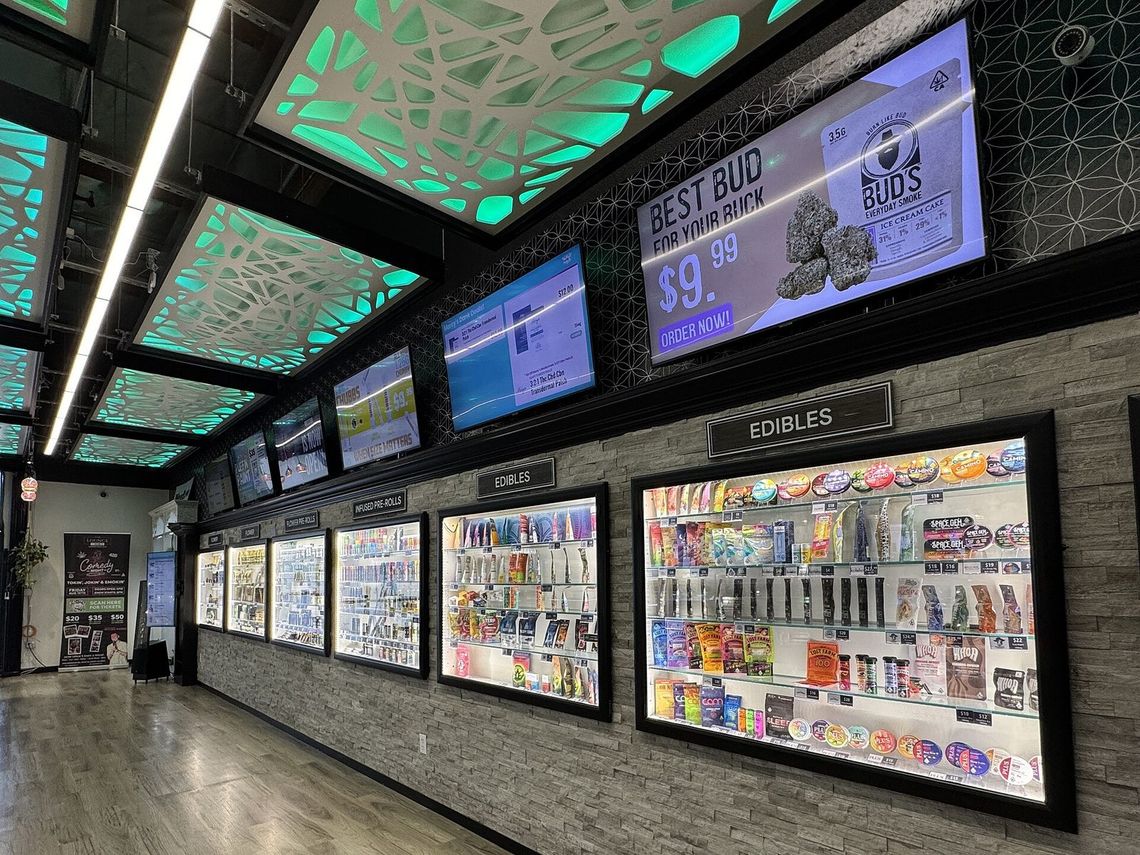
A licensed dispensary checks your age before you shop. In California, customers get into the retail area only after the shop confirms their age and identity, and in New York, staff must inspect each buyer's ID and confirm the buyer is 21 or older.
Each answer below names the California or New York rule behind it. It is a store, not a clinic. If you are visiting from out of town, read the tourist rules guide as well for flying, hotels and state lines, and see the California or New York rules page for limits.

What ID do I need to buy cannabis in California or New York?
Bring a valid government-issued photo ID. California accepts a valid government document, such as a driver's license, that shows your name, date of birth, height, gender and photo, a valid U.S. Armed Forces ID, or a valid passport issued by the United States or any foreign government (4 CCR 15404(c)).
New York accepts a valid driver's license or non-driver ID issued by any U.S. state, U.S. territory, the District of Columbia, the federal government or a Canadian province. It also accepts IDNYC or another valid government ID that shows your age and a photo of your face, a consular ID card, a U.S. military ID, or a valid passport from any country (9 NYCRR 123.10(d)(2)).
California's statute adds a second test: an adult-use shop may not sell to you unless you first show documentation that reasonably appears to be a valid government-issued ID showing you are 21 or older (Business and Professions Code 26140(a)(4)). You do not need a medical recommendation to buy adult-use cannabis at 21 or older.
SourcesCalifornia Department of Cannabis Control: Medicinal and Adult-Use Cannabis Regulations (revised 1 Jul 2026)New York Office of Cannabis Management: Retail Regulations and Compliance Overview (9 NYCRR 123.10)California Legislative Information: Business and Professions Code 26140California Department of Cannabis Control: What's legal
Can I use an expired, paper or phone-photo ID?
Plan on being turned away. California and New York both list only valid identification in their rules, and California's list requires a photo of the person on the government document (4 CCR 15404(c); 9 NYCRR 123.10(d)(2)).
Neither state's rule names expired cards or paper temporary licenses, and a photo of an ID on your phone is not on either list. California's statute asks whether the document reasonably appears to be valid, which leaves the call to the staff member checking it (Business and Professions Code 26140(a)(4)).
If your license has expired or you only have a paper document, bring a valid passport instead. California accepts a passport from the United States or any foreign government, and New York accepts one from any country.
SourcesCalifornia Department of Cannabis Control: Medicinal and Adult-Use Cannabis Regulations (revised 1 Jul 2026)New York Office of Cannabis Management: Retail Regulations and Compliance Overview (9 NYCRR 123.10)California Legislative Information: Business and Professions Code 26140
Why do dispensaries scan your ID, and what happens to the data?
In New York, the scan is part of the age check the rules require before a sale: a dispensary employee may perform a transaction scan of your ID as a precondition to the sale of any cannabis product (9 NYCRR 123.10(d)(3)).
New York also limits what the shop keeps. A dispensary may not acquire or record your personal information without consent, unless it is information typically acquired in a sales transaction, which can include your age (9 NYCRR 123.10(d)(5)).
California's rules require the shop to confirm your age and identity by inspecting a valid ID before you enter the retail area and before any sale (4 CCR 15402(a), 15404(a)). Curbside orders get the same check: staff handing over a purchase at the curb must verify each customer's age (4 CCR 15402(d)).
SourcesNew York Office of Cannabis Management: Retail Regulations and Compliance Overview (9 NYCRR 123.10)California Department of Cannabis Control: Medicinal and Adult-Use Cannabis Regulations (revised 1 Jul 2026)
What happens at check-in and at the counter?
In California, expect an ID check first, then a staffed sales area: customers get into the retail area only after the shop confirms their age and identity, and the licensee or at least one employee must be in the retail area whenever customers are there (4 CCR 15402(a)-(b)).
Bring adults only. A California shop licensed for adult use only may not allow anyone under 21 on its premises, and everyone who works in or handles cannabis at a licensed premises must be 21 or older (Business and Professions Code 26140(a)(2); 4 CCR 15000.6).
In New York, a dispensary may not sell to anyone who is, or appears to be, under 21, or to anyone visibly intoxicated. It must post its license and the allowable possession and purchase limits where customers can see them (9 NYCRR 123.10(d)(1), (e)(2)(ii)).
Your purchase leaves the store in a bag you cannot see through: California requires an opaque exit package (4 CCR 15413(c)). New York dispensaries must also sell or provide lockable, child-resistant storage containers (9 NYCRR 123.10(e)(2)(iv)).
SourcesCalifornia Department of Cannabis Control: Medicinal and Adult-Use Cannabis Regulations (revised 1 Jul 2026)California Legislative Information: Business and Professions Code 26140New York Office of Cannabis Management: Retail Regulations and Compliance Overview (9 NYCRR 123.10)
What can a budtender help with, and what can they not say?
A budtender is retail staff. In New York, the rules keep health claims out of what the shop hands you: consumer-education materials may not make health claims, and cannabis advertising may not make medical claims (9 NYCRR 123.10(i)(2), 129.2(b)(9)).
What shops must give you is state safer-use material. California shops must display the state's SB 540 brochure and offer every new customer a copy at the first purchase (Business and Professions Code 26070.3(b)). New York dispensaries must make OCM public-health and educational materials available, including to delivery customers (9 NYCRR 123.10(i)(1)).
In New York, an employee may also refuse a sale if, in their judgment, it could endanger the customer's health or safety (9 NYCRR 123.10). For medication questions, New York's regulator tells people taking prescription drugs to ask their healthcare provider whether it is safe to use cannabis.
SourcesNew York Office of Cannabis Management: Retail Regulations and Compliance Overview (9 NYCRR 123.10)New York Office of Cannabis Management: Adopted Parts 128 and 129 (9 NYCRR)California Legislative Information: Business and Professions Code 26070.3New York Office of Cannabis Management: Adult-Use Information
What are first-time dispensary deals, and what does the law say?
First-visit promotions are something individual shops choose to run; no California or New York law requires them. The law does limit what a promotion can be.
California bars licensees from giving away any amount of cannabis, cannabis products or accessories as part of a business promotion, and a retailer may not provide free cannabis goods to anyone (Business and Professions Code 26153(a); 4 CCR 15411(a)). California ads also may not promote free goods, including buy-one-get-one-free offers (4 CCR 15040(a)(4)).
New York lets licensees advertise price reductions, discounts and loyalty programs, but bars advertising through giveaways of 'free' or 'donated' cannabis (9 NYCRR 129.3). The retail tax on a discounted item is calculated on the pre-discount price.
A shop's own website is where it states its current promotions and their terms. We do not publish offer codes.
SourcesCalifornia Legislative Information: Business and Professions Code 26153California Department of Cannabis Control: Medicinal and Adult-Use Cannabis Regulations (revised 1 Jul 2026)New York Office of Cannabis Management: Adopted Parts 128 and 129 (9 NYCRR)
What taxes will I see on the receipt?
California's cannabis excise tax is itemized on the receipt. Retailers collect a 15% cannabis excise tax on gross receipts (the rate since 1 Oct 2025, down from 19%) and must give you a receipt that states it separately. Sales tax is charged as well, on a base that includes the excise tax.
A California shop may also add its local cannabis business tax to the receipt as a separate amount, according to CDTFA's retailer guide.
In New York, dispensary sales carry a 9% state retail excise tax and a 4% local excise tax. The receipt the shop offers you must show the dispensary's name, address and license number and list each cannabis tax separately (9 NYCRR 123.10).
Neither state's rules tell shops which payment methods to accept. New York records the method of payment on each sale, but cash, debit or card is the shop's choice, so ask the shop before you go.
SourcesCalifornia Department of Tax and Fee Administration: Tax guide for cannabis retailersNew York Office of Cannabis Management: Adult-Use InformationNew York Office of Cannabis Management: Retail Regulations and Compliance Overview (9 NYCRR 123.10)
Can I return a product?
It depends on the state and the shop. California retailers may accept returns but are not required to, and they may never resell a returned item (4 CCR 15410(b)-(c)).
New York dispensaries must have written policies to track and resolve complaints and product returns, and a returned product is quarantined for disposal rather than put back on the shelf (9 NYCRR 123.10). Keep your receipt: in New York it shows the store's license number and the date and time of sale.
SourcesCalifornia Department of Cannabis Control: Medicinal and Adult-Use Cannabis Regulations (revised 1 Jul 2026)New York Office of Cannabis Management: Retail Regulations and Compliance Overview (9 NYCRR 123.10)
What each state's rules say
The same questions answered by each state's rules page. Each answer links to its source or to the full rule and its sources. All Arizona rules · All California rules · All Colorado rules · All Connecticut rules · All Florida rules · All Illinois rules · All Massachusetts rules · All Maryland rules · All Michigan rules · All Minnesota rules · All Missouri rules · All New Jersey rules · All New Mexico rules · All Nevada rules · All New York rules · All Ohio rules · All Oklahoma rules · All Oregon rules · All Pennsylvania rules · All Texas rules · All Washington rules
| Question | Arizona rules | California rules | Colorado rules | Connecticut rules | Florida rules | Illinois rules | Massachusetts rules | Maryland rules | Michigan rules | Minnesota rules | Missouri rules | New Jersey rules | New Mexico rules | Nevada rules | New York rules | Ohio rules | Oklahoma rules | Oregon rules | Pennsylvania rules | Texas rules | Washington rules |
|---|---|---|---|---|---|---|---|---|---|---|---|---|---|---|---|---|---|---|---|---|---|
| Minimum age | 21+ with valid government photo ID; the statutory interim list includes any valid unexpired passport (A.R.S. 4-241).Source · azleg.gov | 21+ for adult use; 18+ with a physician's recommendation for medicinal useSource · cannabis.ca.gov | 21+ with a valid, unexpired government photo ID; any passport counts and no residency is required (Rule 3-405).Source · drive.google.com | 21+ with a valid government-issued photo ID; no residency rule for adult-use purchases (DCP).Source · portal.ct.gov | Registered Florida patients 18+ with an active registry ID card; minors buy only through a caregiver 21+ (s. 381.986).Source · flsenate.gov | 21+ with valid, unexpired government photo ID showing birth date, scanned at the counter (410 ILCS 705/15-85).Source · ilga.gov (archived) | 21+ with valid government-issued ID, checked at the door and again at the register; bring a photo ID (935 CMR 500.140).Source · masscannabiscontrol.com | 21+ with an ID on the state list: a U.S. license or ID card, or any valid passport; foreign licenses not accepted.Source · regs.maryland.gov | 21+ with a valid driver's license or government photo ID showing proof of age; no residency rule (R 420.505).Source · michigan.gov (archived) | 21+ with a valid U.S. state or Canadian province license or ID, U.S. passport, Tribal ID or foreign passport (342.27).Source · revisor.mn.gov | 21+ with valid, unexpired government-issued photo ID; no residency rule for adult-use buyers (19 CSR 100-1.180).Source · sos.mo.gov | 21+ with photo ID; a U.S. or foreign passport or any state's photo driver's license is accepted (N.J.A.C. 17:30-14.3).Source · nj.gov | 21+ with valid government photo ID; a U.S. or foreign passport works, and no residency is required (16.8.2.40 NMAC).Source · srca.nm.gov | 21+ with an unexpired government photo ID, including a foreign passport (NAC 678B.306).Source · leg.state.nv.us | 21+ to buy, possess or consume adult-use cannabisSource · cannabis.ny.gov | 21+ with a current, valid government-issued photo ID showing birth date, checked at the door and the sale.Source · codes.ohio.gov (archived) | OMMA license holders only, 18+ on their own; minors need a parent present; staff check license and photo ID.Source · oklahoma.gov | 21+ with any country's passport, a U.S. state license or ID, military or tribal ID, NEXUS or SENTRI (ORS 475C.217).Source · oregonlegislature.gov (archived) | No visitor sales: only Pennsylvania-registered patients 18+ (minors through a caregiver) and their caregivers.Source · pa.gov | No statutory patient age; under 18 usually through a guardian; pickup needs ID, name, birth date and SSN digits.Source · dps.texas.gov (archived) | 21+; unexpired U.S. state or Canadian ID, passport, passport card, NEXUS, green card or military ID (WAC 314-55-150).Source · app.leg.wa.gov |
| How much | Possession limit1 oz, no more than 5 g of it concentrate, to carry and per store transaction (A.R.S. 36-2852, 36-2858).Source · azleg.gov | Daily purchase limit28.5 g non-concentrated cannabis, 8 g concentrate and 6 immature plants per customer per daySource · cdn.cannabis.ca.gov | Possession limitBuy 1 oz flower, 8 g concentrate or 800 mg THC in products per transaction (Rule 6-110); possess up to 2 oz.Source · denvergov.org | Possession limit1.5 oz on you, 5 oz locked at home or in a locked glove box or trunk; stores sell up to 1 oz a day.Source · cga.ct.gov | Possession limitPatients: 70-day supply and 4 oz flower. Others: 20 g or less of plant cannabis is a misdemeanor, more is a felony.Source · flrules.org | Possession limitResidents 60 g flower, 10 g concentrate, 1,000 mg THC; visitors 30 g, 5 g and 500 mg (410 ILCS 705/10-10).Source · cannabis.illinois.gov | Possession limit2 oz on you, 10 oz at home; stores sell 2 oz a day, or 10 g THC concentrate or 1,000 mg edibles (St. 2026, c. 65).Source · masscannabiscontrol.com | Possession limit1.5 oz flower, 12 g concentrate or 750 mg THC per day, counted combined; visitors included (COMAR 14.17.12.04).Source · cannabis.maryland.gov | Possession limit2.5 oz on you (no more than 15 g concentrate), 10 oz at home; 2.5 oz per store transaction (MCL 333.27955, R 420.506).Source · legislature.mi.gov (archived) | Possession limit2 oz flower in public (2 lb at home), 8 g concentrate, 800 mg THC in edibles; the same caps apply per sale.Source · revisor.mn.gov | Possession limit3 oz flower or equivalent (24 g concentrate or 2,400 mg THC) per purchase and in possession (Art. XIV, 2.10).Source · revisor.mo.gov | Possession limit1 oz flower, 4 g concentrate or 1,000 mg edibles per sale; over 6 oz is a fourth-degree crime (N.J.S.A. 2C:35-10).Source · nj.gov | Possession limit2 oz cannabis, 16 g extract and 800 mg edibles at one time (26-2C-3); stores may add 6 immature plants a sale.Source · rld.nm.gov | Possession limit2.5 oz usable cannabis or 1/4 oz concentrate, or a mix within the limit (NRS 678D.200).Source · leg.state.nv.us | Possession limit3 oz of cannabis and 24 g of concentrated cannabis (Penal Law 222.05)Source · nysenate.gov | Possession limit2.5 oz plant material and 15 g extract combined (R.C. 3796.221); DCC's daily cap adds 15,000 mg THC for other products.Source · com.ohio.gov | Possession limitLicensees: 3 oz on person, 8 oz at home, 1 oz concentrate, 72 oz edibles; no license: a misdemeanor, up to 1 year.Source · oklegislature.gov | Possession limitCarry 2 oz in public, 8 oz in all (ORS 475C.337); stores sell 2 oz flower and 10 g extract a day (OAR 845-025-2800).Source · oregon.gov | Possession limitPatients: up to a 90-day supply (192 units). Others: 30 g or less is a misdemeanor, up to 30 days, $500 or both.Source · palegis.us (archived) | Possession limitTexas patients: 90-day supply, 10 mg THC a dose, 1 g THC a package; others: 2 oz or less is a Class B misdemeanor.Source · tcss.legis.texas.gov | Possession limit21+: 1 oz flower, 16 oz solid edibles, 72 oz liquid or 200 mg THC in low-dose drinks, 7 g concentrate (RCW 69.50.360).Source · app.leg.wa.gov |
| Tax at the register | Retail tax16% excise (A.R.S. 42-5452) plus sales tax: 9.1% combined in Phoenix, 25.1% of the price in all.Source · phoenix.gov | State excise tax15% of gross receipts since 1 Oct 2025; sales tax is charged on the total after exciseSource · cdtfa.ca.gov | Retail tax15% state retail marijuana sales tax instead of the 2.9% state sales tax, plus local tax: 26.75% combined in Denver.Source · denvergov.org | Retail tax6.35% sales tax, 3% town tax and a flat 10.75% state cannabis tax since Oct 1, 2026 (DRS).Source · portal.ct.gov | Retail taxNo sales tax on purchases from licensed treatment centers (s. 212.08(2)(l)); hemp shop goods get no such exemption.Source · flsenate.gov | Retail tax10%, 20% or 25% state excise by product, plus 16.50% combined sales tax on adult-use in Chicago since August 1, 2026.Source · tax.illinois.gov | Retail tax6.25% sales tax plus 10.75% state excise plus up to 3% local option, so up to 20%; registered medical sales are untaxed.Source · mass.gov | Retail tax12% sales tax on adult-use since July 1, 2025; counties and cities may not add a cannabis tax (Tax-Gen. 11-104).Source · mgaleg.maryland.gov | Retail tax10% marijuana excise plus 6% sales tax on price and excise; wholesalers pay a 24% wholesale tax since January 1, 2026.Source · michigan.gov (archived) | Retail tax15% cannabis gross receipts tax plus 6.875% state sales tax and any local sales tax where you buy.Source · revenue.state.mn.us (archived) | Retail tax6% state marijuana tax plus sales tax; St. Louis, Kansas City and many other cities add 3% (Art. XIV, 2.6).Source · dor.mo.gov | Retail tax6.625% state sales tax plus a local transfer tax of up to 2% where the town levies one; growers pay the SEEF.Source · nj.gov | Retail tax14% cannabis excise since July 1, 2026, plus gross receipts tax: 7.625% in Albuquerque, 8.1875% in Santa Fe.Source · tax.newmexico.gov | Retail tax10% retail excise plus county sales tax: 8.375% in Clark County, 8.265% in Washoe (NRS 372A.290).Source · tax.nv.gov | Retail tax9% state + 4% local on each retail sale; no state or local sales taxSource · cannabis.ny.gov | Retail tax10% adult-use excise plus sales tax: 8.00% in Columbus and Cleveland, 7.80% in Cincinnati (R.C. 3796.40).Source · tax.ohio.gov | Retail tax7% medical marijuana tax plus sales tax: 8.625% in Oklahoma City (Oklahoma County), 8.517% in Tulsa (Tulsa County).Source · oklahoma.gov | Retail tax17% state tax plus up to 3% local, 20% in Portland and Eugene; OMMP cardholders exempt on sales before 2028.Source · oregon.gov | Retail taxNo sales tax on medical marijuana; growers pay a 5% gross receipts tax that may not appear on receipts (MMA 901).Source · palegis.us (archived) | Retail taxHemp and CBD goods: 6.25% state plus up to 2% local sales tax; no Comptroller guidance found on low-THC prescriptions.Source · comptroller.texas.gov | Retail tax37% excise in the shelf price, plus sales tax: 10.55% Seattle, 10.50% Tacoma, 9.10% Spokane (Q4 2026).Source · app.leg.wa.gov |
| How do I know the shop is licensed? | Check ADHS's AZ Care Check database.Full Arizona rule | Check the license in the window first. Retailers must display their state license where customers can see it, and you can scan its QR code to confirm the status, or look the shop up in DCC's license search.Full California rule | Buy only from a store licensed by both the state and its local government.Full Colorado rule | Check DCP's list.Full Connecticut rule | Check the OMMU's list.Full Florida rule | Check the name against IDFPR's list.Full Illinois rule | Check the store against the Commission's records, and expect hours set by the city or town, not the state.Full Massachusetts rule | Check the name on MCA's Dispensary Locator.Full Maryland rule | Check the business against the CRA's license search.Full Michigan rule | Check OCM's licensee spreadsheet.Full Minnesota rule | The Department advises checking its licensed dispensary map before visiting a store.Full Missouri rule | Check the CRC's Find a Dispensary map first. The page says New Jersey has more than 320 licensed dispensaries, and the CRC says every legal dispensary is added to the map once it tells the agency it is operational.Full New Jersey rule | Check the license. The CCD runs a public license search, and every licensed premises must display its division license in a conspicuous place, within plain sight of the public where the premises is open to customers (16.8.2.8 NMAC).Full New Mexico rule | The only legal place to buy is a state-licensed retail store, and the CCB's FAQ says a legitimate store is a walk-in storefront with clear signage that must conspicuously post its Nevada cannabis establishment license and business license.Full Nevada rule | Look for OCM's Dispensary Verification Tool near the main entrance and scan its QR code.Full New York rule | Check the name against DCC's own list.Full Ohio rule | Check the license. Every OMMA commercial licensee must post its license in a conspicuous place on the licensed premises (OAC 442:10-5-1.1), and OMMA Verify on the MedPortal shows whether a license number is active.Full Oklahoma rule | Check the store against OLCC's license data.Full Oregon rule | Check the Department of Health's list.Full Pennsylvania rule | DPS's Licensed Dispensaries page, last captured on July 8, 2026, lists three active Texas Compassionate Use Program licenses: Fluent, formerly Cansortium Texas (license 0004), Texas Original (0005) and goodblend, operated by Surterra Texas LLC (0006).Full Texas rule | The LCB's licensee list shows whether a store is licensed.Full Washington rule |
| What tax will I pay? | Adult-use purchases carry a 16 percent excise tax on the price of all marijuana and marijuana products a marijuana establishment sells to a consumer (A.R.S. 42-5452).Full Arizona rule | You pay a 15% state cannabis excise tax on the gross receipts of each retail sale, plus sales tax.Full California rule | Retail cannabis carries a 15 percent state retail marijuana sales tax at the register.Full Colorado rule | Three taxes apply to every adult-use sale at a retailer, hybrid retailer or micro-cultivator: the 6.35 percent state sales and use tax, a 3 percent municipal tax on gross receipts that goes to the town where the store is, and the statewide cannabis tax (Department of Revenue Services; Conn. Gen. Stat. 12-330mm).Full Connecticut rule | It is not taxed at the register.Full Florida rule | Illinois taxes adult-use cannabis by product type.Full Illinois rule | Adult-use cannabis carries up to 20 percent in taxes at the register.Full Massachusetts rule | Adult-use cannabis carries a 12 percent state sales and use tax.Full Maryland rule | Two taxes appear at the register on an adult-use sale.Full Michigan rule | Adult-use cannabis carries a 15 percent gross receipts tax on retail sales of taxable cannabis products, which include flower, cannabis products, vape cartridges, hemp-derived consumer products and lower-potency hemp edibles (Minn. Stat. 295.81).Full Minnesota rule | Adult-use cannabis pays a 6 percent state marijuana tax on the retail price, collected by the dispensary for the Department of Revenue (Article XIV, Section 2.6(1)).Full Missouri rule | Expect state sales tax and, in some towns, a local tax.Full New Jersey rule | New Mexico adds a cannabis excise tax of 14 percent of the price paid on adult-use sales from July 1, 2026 through June 30, 2027 (NMSA 7-42-3).Full New Mexico rule | Three taxes sit on an adult-use purchase.Full Nevada rule | Each adult-use retail sale carries a 9% state tax and a 4% local tax (Tax Law 493), 13% in total.Full New York rule | Ohio adds a 10 percent excise tax to the price of adult-use marijuana, paid by the consumer to the dispensary at the time of sale, in addition to state and local sales tax (R.C. 3796.40(B), (C)).Full Ohio rule | Every retail medical marijuana sale carries a 7 percent state tax on the gross amount the seller receives, collected at the point of sale (63 O.S. 426), and OMMA's rules have dispensaries collect it from the customer, who must be a licensed patient or caregiver (OAC 442:10-5-7).Full Oklahoma rule | Oregon charges a 17 percent state tax on the retail price of every marijuana item, from flower and immature plants to edibles, concentrates, extracts and topicals (ORS 475C.674).Full Oregon rule | Patients pay no sales tax: medical marijuana is exempt from the state sales tax imposed under section 202 of the Tax Reform Code of 1971 (35 P.S. 10231.901(e)).Full Pennsylvania rule | The tax visitors meet is ordinary sales tax on the hemp and CBD products sold in shops.Full Texas rule | Every retail sale of cannabis carries a 37 percent excise tax on the selling price (RCW 69.50.535).Full Washington rule |
Rule changes behind this guide
Dated stops from the state rules pages, newest first, each with its source.
New Mexico
Excise tax rises to 14 percent
The cannabis excise tax moved to 14 percent for July 1, 2026 to June 30, 2027 and is scheduled to reach 18 percent on July 1, 2030.
Source · tax.newmexico.govCalifornia
Excise tax returns to 15%
The rate went back to 15% and is set to hold through 30 Jun 2028.
Source · leginfo.legislature.ca.govCalifornia
AB 564 takes effect
AB 564 (Stats. 2025, ch. 127) amended the excise tax law, keeping 19% only through 30 Sep 2025.
Source · leginfo.legislature.ca.govCalifornia
Excise tax rises to 19%
CDTFA raised the cannabis excise tax from 15% to 19% of gross receipts for retail sales on and after 1 Jul 2025.
Source · cdtfa.ca.govNew Mexico
Excise tax rises to 13 percent
The first scheduled increase in the cannabis excise tax took effect, from 12 to 13 percent, with one more point due each July 1 through 2030.
Source · tax.newmexico.govNew York
Current cannabis tax rates begin
The Tax Department's current rates, a 9% distributor tax and retail taxes totaling 13%, apply to sales on and after this date (per an Internet Archive capture of its page, 13 Aug 2026).
Source · tax.ny.gov (archived)California
Excise tax moves to gross receipts
The cannabis excise tax began applying to gross receipts from retail sales at 15%.
Source · cdtfa.ca.govNew Mexico
Adult-use sales begin
Licensed recreational sales began statewide with around 250 retailers licensed on day one, under a 12 percent cannabis excise tax.
Source · rld.nm.govIllinois
Adult-use sales begin
IDFPR describes the controlled legalization of adult use cannabis beginning January 1, 2020, the same date the cannabis purchaser excise tax of 10, 20 or 25 percent took effect.
Source · idfpr.illinois.govMichigan
First adult-use licenses and the 10 percent excise
Treasury says the 10 percent excise tax began to be imposed in November 2019, when the agency issued the first adult-use licenses.
Source · michigan.gov (archived)Nevada
Licensed medical dispensaries authorized (SB 374)
Senate Bill 374 of the 2013 session provided for the registration of medical marijuana establishments to cultivate, produce and dispense cannabis to cardholders, registered their agents and imposed an excise tax on medical sales.
Source · leg.state.nv.us
Questions
What should I bring to a dispensary?
A valid government photo ID. California accepts a driver's license or other government document with your photo, a U.S. military ID, or a passport from any country, and New York also accepts IDNYC, consular IDs and Canadian provincial licenses. You do not need a medical card to buy adult-use cannabis at 21 or older. Payment methods are up to each shop.
Source: cdn.cannabis.ca.gov
Are first-time dispensary deals guaranteed?
No. First-visit promotions are something individual shops choose to run, with their own terms, and no state law requires them. California bars licensees from giving cannabis away as a business promotion, and New York bars licensees from advertising through giveaways of free or donated cannabis. A shop's own website is where it states its current promotions; we do not publish offer codes.
Source: leginfo.legislature.ca.gov
Why do they scan your ID at a dispensary?
To confirm you are 21 or older before the sale, which both states require. New York's rule lets staff run a transaction scan of your ID as a precondition to any sale, and it bars the shop from recording your personal information without consent beyond what a normal sale captures, such as your age.
Source: cannabis.ny.gov
Can I go to a dispensary with an expired ID?
Plan on being turned away. California and New York rules list only valid IDs, and California's statute allows a sale only when your ID reasonably appears to be valid. A valid passport from any country is accepted in both states, so bring one if your license has expired.
Source: cdn.cannabis.ca.gov
Can you use a paper ID at a dispensary?
Neither state lists a paper temporary license by name. California's rule asks for a government document that shows your photo, and New York's list covers valid IDs only, so the staff member decides. If your plastic card is not in hand, bring a valid passport or another photo ID from the state lists.
Source: cdn.cannabis.ca.gov
Can I use a foreign passport at a dispensary?
Yes. California accepts a valid passport issued by the United States or by any foreign government, and New York accepts a valid passport issued by the United States or any other country. New York also accepts consular ID cards and valid Canadian provincial driver's licenses.
Source: cannabis.ny.gov
Can someone under 21 come into the dispensary with me?
Not into a California adult-use shop. State law bars an adult-use licensee from allowing anyone under 21 on its premises unless the same premises also hold a medicinal license. In New York, a dispensary may not sell to anyone who is, or appears to be, under 21.
Source: leginfo.legislature.ca.gov
How much cannabis can I buy in one visit?
In California, a shop may sell one adult-use customer up to 28.5 g of non-concentrated cannabis, 8 g of concentrate and 6 immature plants per day (4 CCR 15409). In New York, adults 21 and older may possess up to 3 oz of cannabis and 24 g of concentrate, and dispensaries must post the purchase limits in the store.
Source: cdn.cannabis.ca.gov
How do I know the dispensary is licensed?
Look at the entrance. California shops must post a DCC QR code certificate in the front window or an outside case within 3 feet of a public entrance (4 CCR 15039(c)), and California's regulator says you can scan it to verify the license. New York shops post a state Licensed Cannabis Dispensary decal and OCM's Dispensary Verification Tool near the main entrance.
Source: cdn.cannabis.ca.gov
What taxes will I pay at a dispensary?
In California, a 15% cannabis excise tax (since 1 Oct 2025) that the receipt must state separately, plus sales tax; a shop may also add its local cannabis business tax as a separate amount. In New York, a 9% state retail excise tax and a 4% local excise tax, listed separately on the receipt the shop offers you.
Source: cdtfa.ca.gov
Find a licensed shop
Every shop on these city guides holds a state license we checked with the regulator.
Pacific Line
CaliforniaSilver Line
NevadaEmpire Line
New YorkSources (10)Last reviewed 23 Sep 2026
- California Department of Cannabis Control: Medicinal and Adult-Use Cannabis Regulations (revised 1 Jul 2026) (accessed 23 Sep 2026)
- California Legislative Information: Business and Professions Code 26140 (accessed 23 Sep 2026)
- California Legislative Information: Business and Professions Code 26153 (accessed 23 Sep 2026)
- California Legislative Information: Business and Professions Code 26070.3 (accessed 23 Sep 2026)
- California Department of Cannabis Control: What's legal (accessed 23 Sep 2026)
- California Department of Tax and Fee Administration: Tax guide for cannabis retailers (accessed 23 Sep 2026)
- New York Office of Cannabis Management: Retail Regulations and Compliance Overview (9 NYCRR 123.10) (accessed 23 Sep 2026)
- New York Office of Cannabis Management: Adopted Parts 128 and 129 (9 NYCRR) (accessed 23 Sep 2026)
- New York Office of Cannabis Management: Adult-Use Information (accessed 23 Sep 2026)
- NYC Health: Cannabis (Marijuana) (accessed 23 Sep 2026)
Keep going
Next stop on the Before you buy lineG9Do dispensaries take credit cards? Cash, debit and pay-by-bank apps
Most licensed dispensaries in California and New York take cash and debit, not credit cards, because of federal law and the card networks' rules. Bring cash or debit, or link a bank account to a pay-by-bank app first.
Read the guide →Before you buy
- First dispensary visitYOU ARE HEREWhat ID works in California and New York, why the counter scans it, what the law says about first-time deals, and which taxes appear on your receipt.
- Do dispensaries take credit cards?Most licensed dispensaries in California and New York take cash and debit, not credit cards, because of federal law and the card networks' rules. Bring cash or debit, or link a bank account to a pay-by-bank app first.
- Are dispensaries open on Thanksgiving, Christmas and New Year's Day?Massachusetts law shuts most stores on Thanksgiving and Christmas Day; elsewhere each shop decides. Juva closes on Thanksgiving and Christmas Day; Purple Lotus, KOLAS, Planet 13 and 420 Sahara say they open.
- Can you go to a dispensary at 18?Not for adult use: the 17 adult-use states in this guide set the age at 21, and Florida, Pennsylvania, Oklahoma and Texas sell only to patients. At 18 to 20 you must be a patient, and San Jose bars everyone under 21.
- How much cannabis can you buy at once?From 1 oz in Colorado, Arizona, New Jersey, Washington and Connecticut to 3 oz in New York and Missouri; Illinois visitors get half. Limits in 21 states, four of them medical only, with the law for each.
- How to read a cannabis labelThe universal symbol, THC per serving and per package, batch and lot numbers, lab certificates, dates and warnings: what California and New York require on every licensed package.
- Is delta-8 THC legal?Federal hemp law narrows on 12 Nov 2026 and again after 11 Dec, when it expressly excludes delta-8 made from CBD. The delta-8 rules in 21 states, from Florida's hemp shops to Texas's Schedule I.
- Edibles basicsEdibles act more slowly than smoking. State health agencies give the timing, the 10 mg serving cap, safe storage and what to do if a child or pet eats one. Education, not medical advice.
On the move
- Tourist cannabis rulesVisitors 21+ can buy in the 17 adult-use states this guide covers, often with a foreign passport, but cannot take cannabis across a state line. Florida, Pennsylvania, Oklahoma and Texas are medical-only.
- Dispensaries near DisneylandAnaheim bans cannabis stores and delivery businesses. The nearest licensed dispensaries to Disneyland are four in Stanton, 4.2 to 4.4 miles away, and 17 in Santa Ana within 8 miles. Resort rules, delivery, buses.
- Can you smoke cannabis in a hotel room?Usually not. California, Colorado and Connecticut ban smoking and vaping in every hotel room, Ohio limits both to homes and farms, and six states cap rooms for cannabis smoke. Elsewhere hotels or medical cards decide.
- Where can you legally use cannabis in public?Across 21 states: three lounges on Nevada's list, five in New Jersey, twelve Colorado hospitality licenses, five in Michigan (Feb 2026) and 27 in New Mexico (Sep 2026). Most other states have none open.
- Can you fly with cannabis?TSA's Medical Marijuana page has said 'Yes (Special Instructions)' since 27 Apr 2026, but adult-use cannabis stays Schedule I. This guide adds what 21 states and their main airports say, from LAX and PDX to BWI.
- Can you bring cannabis on a cruise?No. Seven major lines bar marijuana in their own rules, medical cards included, and four also name CBD. What federal law and CBP add, and the rules at homeports and ports of call from Long Beach to Mexico.
- Driving with cannabis in the carIn the 17 adult-use states covered here, adults may carry a legal amount in a car, stored as the state requires. Driving impaired is illegal in all 21, and most visitors may not carry it in the four medical-only states.
- Cannabis on Amtrak, in rental cars and in Uber or LyftAmtrak bans marijuana in any form, even where it is legal. Rental fleets are smoke-free, Uber bars drug use, Lyft says to keep illegal substances out, and most of the 21 states covered here ban smoking it in moving cars.
- Can you bring cannabis into a national park?No. 36 CFR 2.35 bans cannabis in every national park, whatever state law says, and the April 2026 rescheduling left adult-use cannabis in Schedule I. Park notes from Yosemite and Cape Cod to the Everglades and Big Bend.